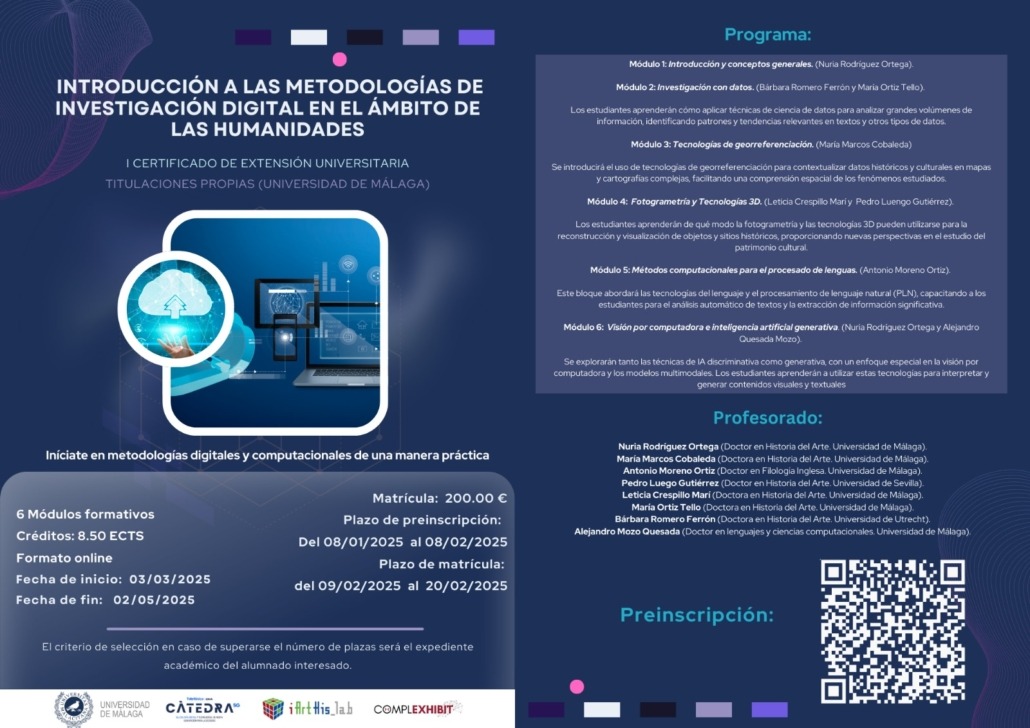
INTRODUCTION TO DIGITAL RESEARCH METHODOLOGIES IN THE HUMANITIES
I University Extension Certificate - University of Málaga
Do you want to learn computational methodologies to apply them to your field of research in the humanities and don't know how? With this course, you have the solution: an introduction to the main digital and computational methods that are currently being used in humanities research.
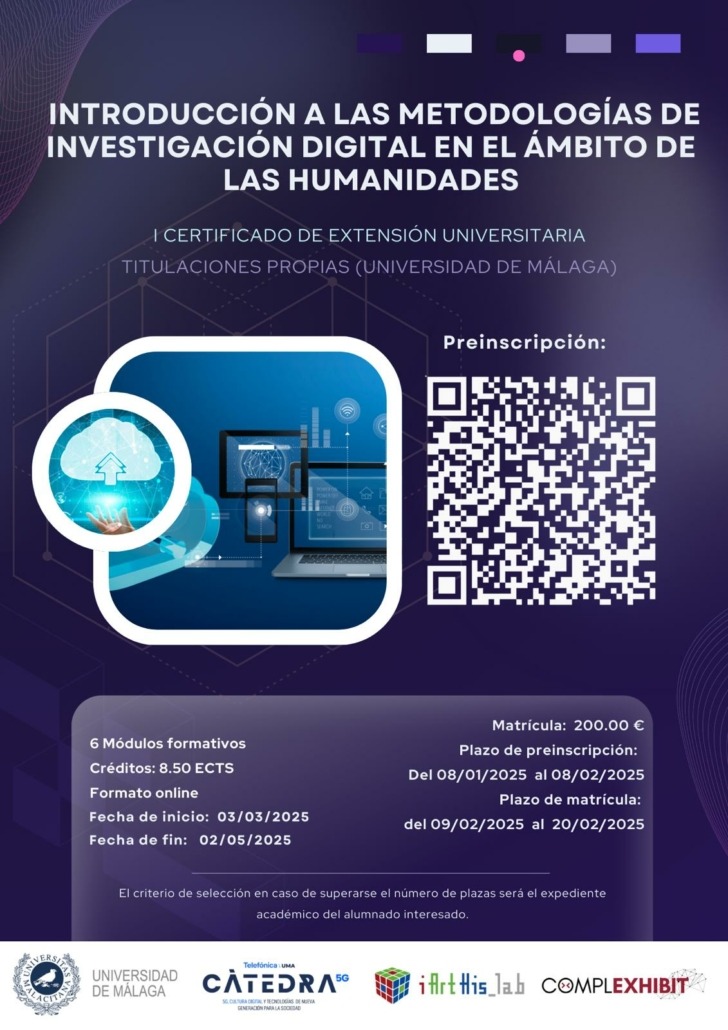
Important dates:
Pre-registration deadline: from 8 January to 8 February 2025
Enrolment deadline: from 9 to 20 February 2025
Date of payment: until 20 February 2025
Location: Fully online through the UMA Virtual Campus
Tariff: 200 €
Duration and credits: 8,5 ECTS
Number of places: 30
Organisation: Telefónica-UMA Chair, University of Málaga
The course will start on 3 March and end on 5 May 2025.
Get introduced to digital and computational methodologies in a practical way.
Programme:
Introduction and general concepts. Nuria Rodríguez Ortega.
2. Data research. Bárbara Romero Ferrón and María Ortiz Tello. Students will learn how to apply data science techniques to analyse large volumes of information, identifying relevant patterns and trends in text and other types of data.
3. Georeferencing technologies. María Marcos Cobaleda. The use of georeferencing technologies will be introduced to contextualise historical and cultural data in complex maps and cartographies, facilitating a spatial understanding of the phenomena studied.
4. Photogrammetry and 3D Technologies. Pedro Luengo Gutiérrez and Leticia Crespillo Marí. Students will learn how photogrammetry and 3D technologies can be used for the reconstruction and visualisation of historical objects and sites, providing new perspectives in the study of cultural heritage.
5. Computational methods for language processing. Antonio Moreno Ortiz. This block will address language technologies and natural language processing (NLP), training students in the automatic analysis of texts and the extraction of meaningful information.
6. Computer vision and generative artificial intelligence. Nuria Rodríguez Ortega and Alejandro Quesada Mozo. Both discriminative and generative AI techniques will be explored, with a special focus on computer vision and multimodal models. Students will learn how to use these technologies to interpret and generate visual and textual content.
Faculty:
Nuria Rodríguez Ortega. PhD in Art History. University of Malaga.
María Marcos Cobaleda. PhD in Art History. University of Malaga.
Antonio Moreno Ortiz. PhD in English Philology. University of Malaga.
Pedro Luego Gutiérrez. PhD in Art History. University of Seville.
Leticia Crespillo Marí. PhD in History of Art. University of Malaga.
Maria Ortiz Tello. PhD in History of Art. University of Malaga.
Bárbara Romero Ferrón. PhD in Art History. University of Utrecht.
Alejandro Mozo Quesada. Degree in Computer Engineering. University of Malaga.