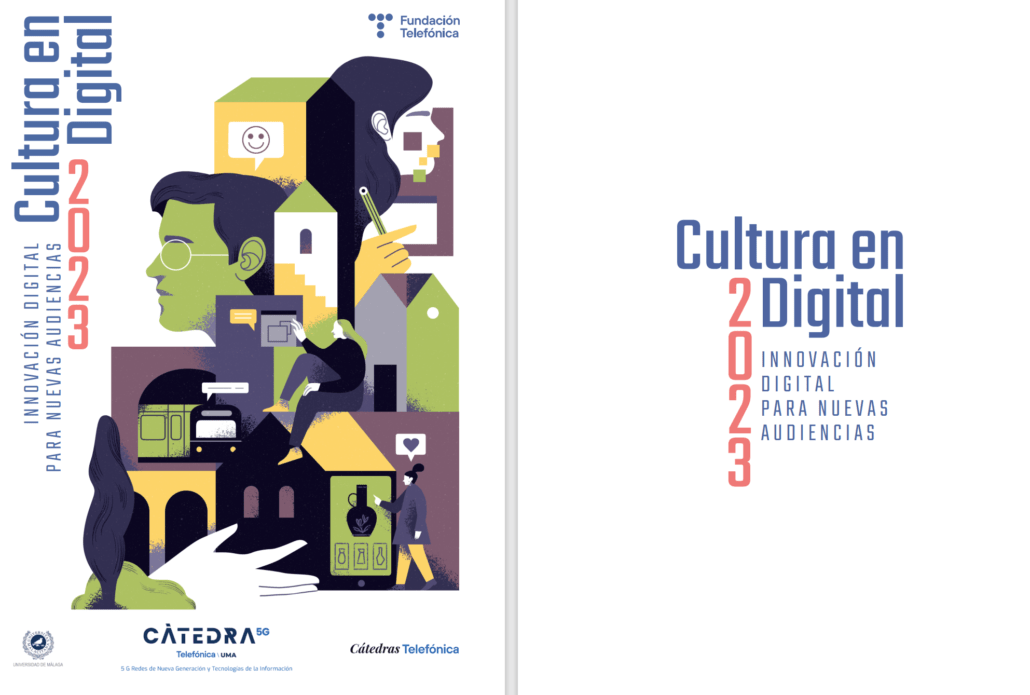
Last October, and in the context of the III Digital Culture Forum, the Telefónica Foundation and the University of Malaga presented the book Culture in Digital: Digital innovation for new audiences, coordinated by Nuria Rodríguez Ortega (Director of the 5G Chair, focused on next generation networks and information technologies at the University).

The digital transformation has induced significant changes in all aspects of culture. These changes are not only evident in the way cultural goods are produced and consumed, but have also redefined the very essence of culture. Emerging technologies have gone beyond their role as simple tools for creators, opening up a range of possibilities for the creation of new artistic genres and disciplines. Moreover, the way in which cultural products are distributed and enjoyed has undergone substantial changes, both in quantitative and qualitative terms, in the way consumers interact with them. With the aim of exploring these changes, and in line with the values that motivate our initiatives, in 2021, the Telefónica Foundation promoted the Digital Culture Forum. This initiative was influenced by the recent pandemic, with the understanding that the experiences, though difficult, offer valuable lessons and that the crisis would have profound and lasting cultural implications.

The publication gathers ideas and thoughts from a variety of artists, art market experts, and representatives of leading cultural institutions in Spain and Latin America. These include the Thyssen-Bornemisza Museum, the National Library of Spain, the Royal Theatre of Madrid, the Juan March Foundation, as well as the Lima Art Museum (MALI) and the Museum of Contemporary Art (MAC) in Lima. In addition, it is enriched by the perspectives of experts from various universities, with the participation of the University of Malaga being particularly noteworthy. This book seeks to contribute to the social dialogue on culture in the digital era.

It also exhaustively reviews current issues related to technological innovation and cultural environments. In this sense, and in the face of this panorama, it becomes essential to critique the technologies we use from political, economic, ideological and environmental perspectives. Such innovation is radically modifying the dynamics, interactions and ways of creating meaning in these environments. This publication aims to contribute to this important critical task and invites us to reflect deeply on the influence that digital innovation has on new audiences from a broad perspective, which encourages us to face the challenges and possibilities of our digital age without hesitation.

Click on the image to go to the download link of the book: