The digital transformation of the art world. Meeting with Harald Klinke
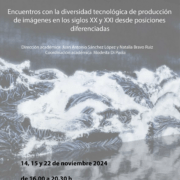
Digital art historian Harald Klinke visits our auditorium to talk about imagination and image in times of artificial intelligence.
The digital transformation we are undergoing applies to all areas of our lives, including the images we perceive. The digital art historian Harald Klinke visits our auditorium to talk about imagination and image in times of artificial intelligence.
Technological innovation has always had an impact on art and, consequently, art history is increasingly using digital methods to observe and analyse these developments.
Big data, machine learning and artificial intelligence challenge the notion of the artist, creativity and the way we think about art. Harald Klinke's work introduces us to the latest technologies applied to image generation, their consequences for artists and for our collective visual memory.
Transformation models such as Dall-e 2 are machine learning models (machine-learning) to generate digital images from natural language descriptions based on millions of images on the web. These new visual phenomena have recently been the subject of much debate on social media, raising questions about the nature of such images and the role of artificial intelligence in art: How can we understand this new phenomenon in a historical context? What does it mean for our human perception? More to the point: What then is the future of art?
To discuss these issues, Harald Klinke will talk with Javier Navarro, Director of Strategy for the SOLO Art Collection, in a meeting moderated by researcher and curator María Santoyo.
To attend this meeting in person, book your free ticket on this page. Access will be allowed until full capacity is reached.
This meeting will have simultaneous translation, will be interpreted into LSE and can be followed at streaming openly on this website and on social networks with the hashtag #HaraldKlinke.
You can follow the event live, starting at 19:00h..:
Harald Klinke (@HxxxKxxx)
Professor of Digital Art History at LMU Munich, Germany. He studied art history, media theory, painting, philosophy and business informatics in Karlsruhe, Berlin, Göttingen and Norwich (UK), obtaining his PhD at the Hochschule für Gestaltung in Karlsruhe. From 2008 to 2009, he worked as a lecturer in visual studies (Bildwissenschaft) at the Department of Art History at the University of Göttingen, where he developed «Visual Literacy». From 2009 to 2010, he conducted research, supported by the German Research Foundation, as a visiting scholar at Columbia University, New York. He is Editor-in-Chief of the International Journal of Digital Art History and a member of the DFG Focus Program Committee ‘....‘The Digital Image‘. In 2021 he completed his habilitation at the LMU Munich with the thesis ‘.‘Interfaces, Interactions and Infrastructures. Image-based application systems for art history and digital humanities and is a Senior Lecturer in Modern and Digital Art History.