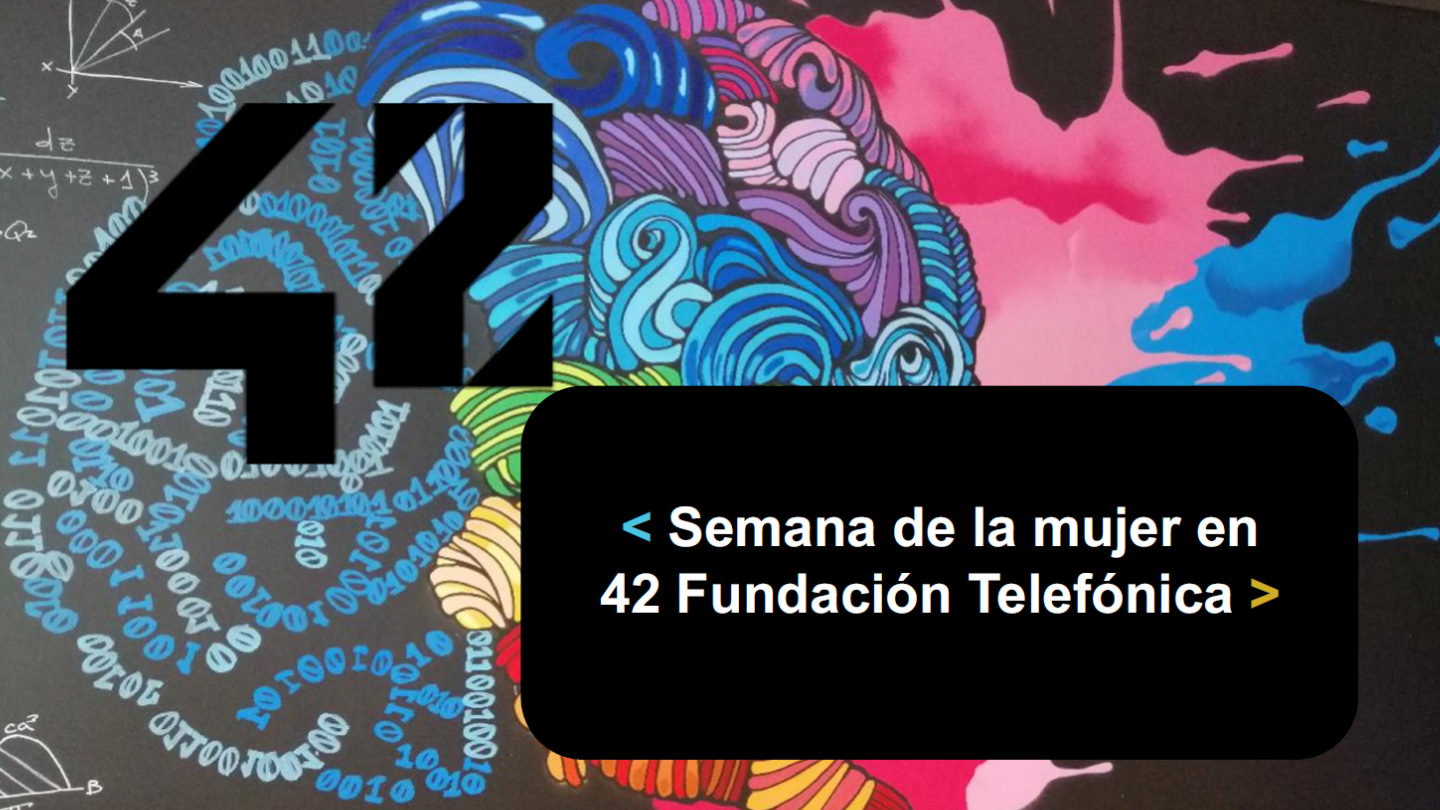
On the occasion of 8 March, 42 is filled with voices that seek to inspire and demonstrate that talent has no gender. For this reason, the campuses will host a multitude of talks, round tables, exhibitions and immersive workshops to bring technology closer to girls, teenagers and women from different contexts. In addition, and with the aim of ensuring that no one is left behind in this digital revolution, Fundación Telefónica's Social Action area is joining the activities by bringing the world of programming and Artificial Intelligence to various social organisations in Madrid, the Basque Country, Barcelona and Malaga.
Digital art historian Harald Klinke visits our auditorium to talk about imagination and image in times of artificial intelligence.
The digital transformation we are undergoing applies to all areas of our lives, including the images we perceive. The digital art historian Harald Klinke visits our auditorium to talk about imagination and image in times of artificial intelligence.
Technological innovation has always had an impact on art and, consequently, art history is increasingly using digital methods to observe and analyse these developments.
Big data, machine learning and artificial intelligence challenge the notion of the artist, creativity and the way we think about art. Harald Klinke's work introduces us to the latest technologies applied to image generation, their consequences for artists and for our collective visual memory.
Transformation models such as Dall-e 2 are machine learning models (machine-learning) to generate digital images from natural language descriptions based on millions of images on the web. These new visual phenomena have recently been the subject of much debate on social media, raising questions about the nature of such images and the role of artificial intelligence in art: How can we understand this new phenomenon in a historical context? What does it mean for our human perception? More to the point: What then is the future of art?
To discuss these issues, Harald Klinke will talk with Javier Navarro, Director of Strategy for the SOLO Art Collection, in a meeting moderated by researcher and curator María Santoyo.
To attend this meeting in person, book your free ticket on this page. Access will be allowed until full capacity is reached.
This meeting will have simultaneous translation, will be interpreted into LSE and can be followed at streaming openly on this website and on social networks with the hashtag #HaraldKlinke.
You can follow the event live, starting at 19:00h..:
Professor of Digital Art History at LMU Munich, Germany. He studied art history, media theory, painting, philosophy and business informatics in Karlsruhe, Berlin, Göttingen and Norwich (UK), obtaining his PhD at the Hochschule für Gestaltung in Karlsruhe. From 2008 to 2009, he worked as a lecturer in visual studies (Bildwissenschaft) at the Department of Art History at the University of Göttingen, where he developed «Visual Literacy». From 2009 to 2010, he conducted research, supported by the German Research Foundation, as a visiting scholar at Columbia University, New York. He is Editor-in-Chief of the International Journal of Digital Art History and a member of the DFG Focus Program Committee ‘....‘The Digital Image‘. In 2021 he completed his habilitation at the LMU Munich with the thesis ‘.‘Interfaces, Interactions and Infrastructures. Image-based application systems for art history and digital humanities and is a Senior Lecturer in Modern and Digital Art History.
https://catedratelefonicauma.es/wp-content/uploads/2022/11/encuentro_haraldklinke_telefonica_22.png4871015Leticia Crespillohttps://catedratelefonicauma.es/wp-content/uploads/2024/10/catedra-2024-cab-web.pngLeticia Crespillo2022-11-29 12:23:342023-03-07 07:24:32The digital transformation of the art world. Meeting with Harald Klinke
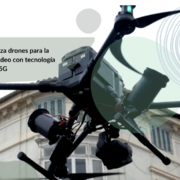
Telefónica R&D and Telefonica Ingeniería y Seguridad (TIS), in collaboration with the Port Authority and the Local Police of Malaga, has successfully executed two use cases using drone flights for video transmission over a private 5G network.
With this test, Telefónica R&D has demonstrated that the 5G private network allows real-time transmission of high quality, high definition video using the bandwidth available with this new technology, and that this transmission is more secure and efficient as it is carried out over a private network and uses edge computing resources to store the generated video.
For this proof of concept, a private 5G network was deployed in the port of Malaga and on Calle Larios, and a software-based 5G Non-Standalone core 5G solution was deployed by the University of Malaga (UMA), an institution also participating in the Andalusia 5G pilot project. Through RANSharing MOCN network sharing technology, Telefónica Móviles' commercial 4G/5G antennas in the area have been used to simultaneously cover both Movistar's commercial network and the private network through a distinct network indicator (PLMN).
The drone was piloted by Telefonica Ingeniería y Seguridad (TIS) personnel, specifically a DJI Matrice 300 RTK. The drone controller has been connected to a backpack equipped with a 5G module that has allowed the generation of a stream video that can be viewed in real time and, in addition, be stored in a video platform developed by Telefonica R&D for this use case.
The Port of Malaga carried out a reconnaissance flight around the port and with different camera approaches, while the Malaga police selected Calle Larios as a point of interest to test the capabilities of the drone and the quality of the video generated. In addition to the Port Authority and members of the Local Police, the tests were attended by members of the National Police and the Civil Guard, who showed interest in the potential uses of the combination of drones, private 5G networks and video analytics.
https://catedratelefonicauma.es/wp-content/uploads/2022/11/telefonica_drones_Malaga2022.png10801920Leticia Crespillohttps://catedratelefonicauma.es/wp-content/uploads/2024/10/catedra-2024-cab-web.pngLeticia Crespillo2022-11-25 11:18:192023-03-07 07:24:32Telefónica uses drones for video transmission with 5G technology
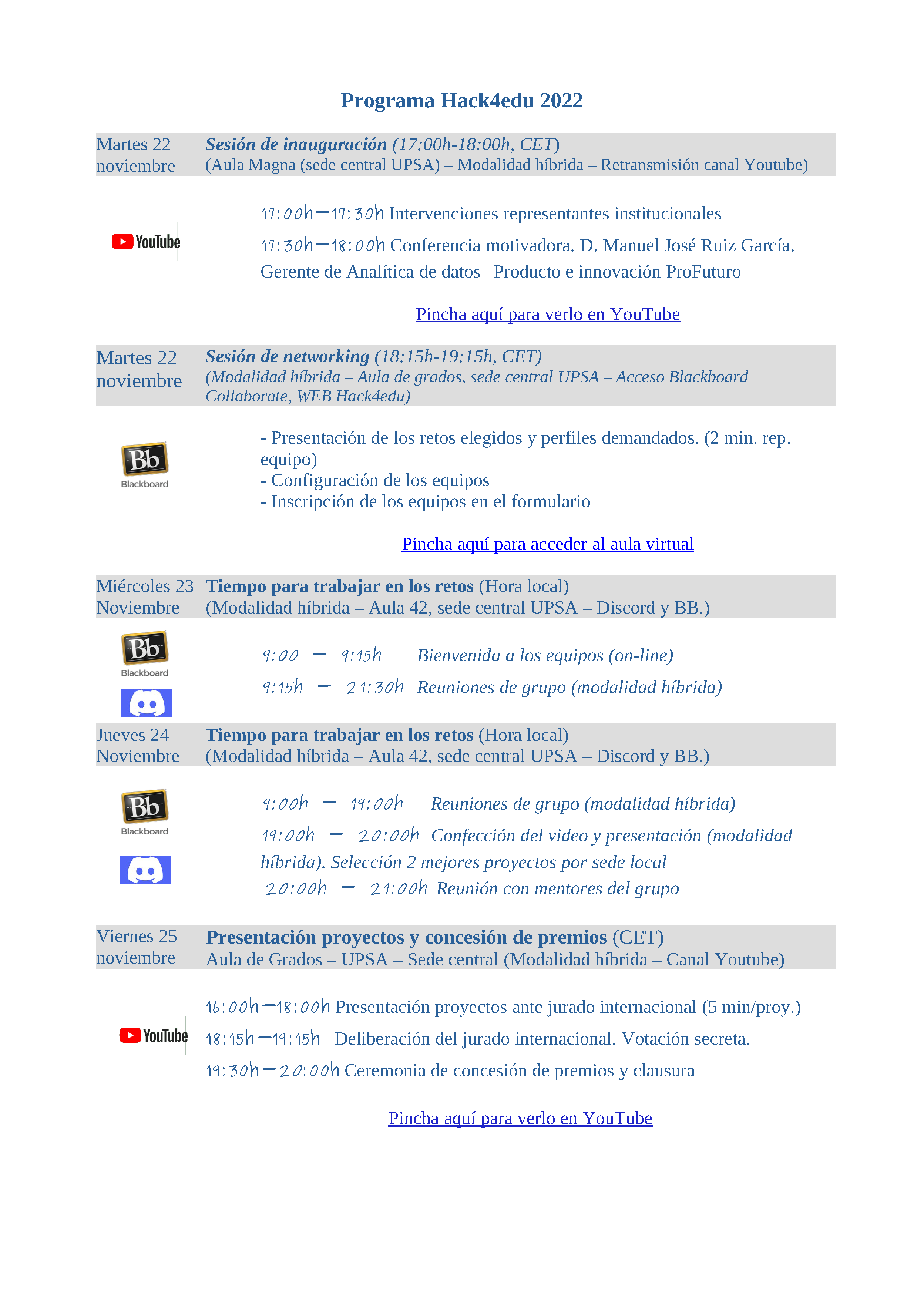
The 3rd edition of #hack4edu (international digital education hackathon) will take place from 22 to 25 November 2022 and is open to anyone involved in programming, computer science, telecommunications, education, pedagogy.
#hack4edu is an international initiative, so people from anywhere in the world can participate. Proposals will be accepted in Spanish and Portuguese.
The objective for Telefónica Chair universities is to disseminate the event and encourage their students to participate. Among the novelties, this year the best projects will be published in an international conference, as lecture notes by Springer.
Deadlines:
Challenges/projects to be developed can be submitted until the 21st.
Hackers can register until 18 November.
https://catedratelefonicauma.es/wp-content/uploads/2022/11/H4Edu_Banner.jpg10801080Leticia Crespillohttps://catedratelefonicauma.es/wp-content/uploads/2024/10/catedra-2024-cab-web.pngLeticia Crespillo2022-11-17 11:11:192023-03-07 07:24:32RCT - III International Hackathon on Digital Education - Hack4Edu
This is a global conference promoted by Fundación Telefónica, IE University, South Summit and Fundación “la Caixa” that brings together leading international experts in education, technology and innovation to reflect on the challenges posed in the field of learning and draw practical conclusions around the great debate on education in the digital age.
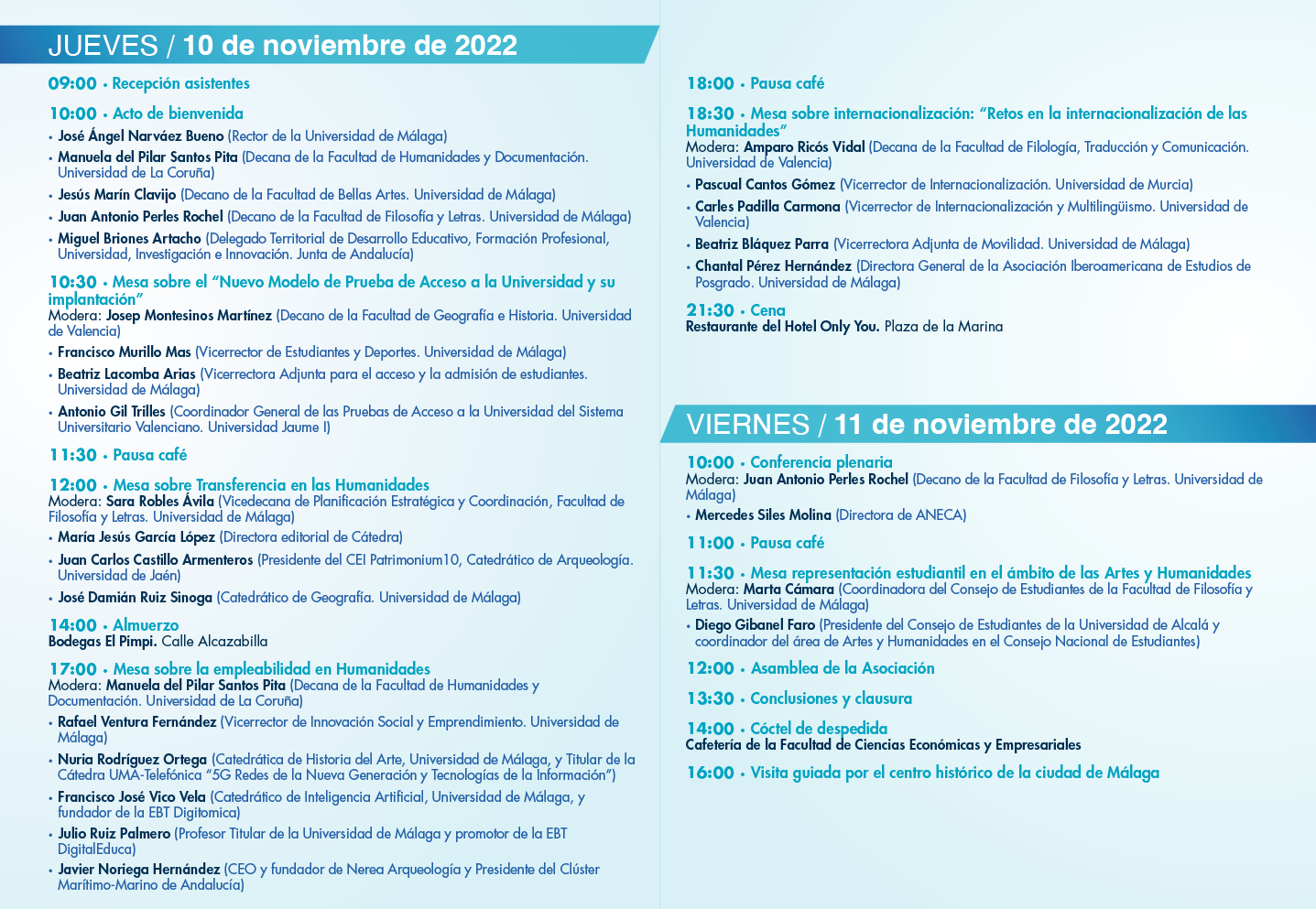
Yesterday and the day before took place in Malaga the XXVIII Conference of Deans of Arts and Humanities. This event was held at the Faculty of Economics and Business Studies of the University of Malaga (Campus del Ejido) and was attended by numerous speakers, among which were Nuria Rodríguez Ortega,Professor of Art History and director of the Telefónica-UMA Chair «5G Next Generation Networks and Information Technologies».
The conference, made up of round tables on different topics, focuses on the future challenges facing the university institution, discussing the possible solutions that can be found, offering answers from all the areas of knowledge that make up this community.
Thus, from 09:00 in the morning of Thursday 10th November to 16:00 on Friday 11th November, all the participants showed their point of view and their ideas. Finally, a guided tour of the historic centre of the city of Malaga and a farewell cocktail made this event a very fruitful meeting to exchange impressions.
https://catedratelefonicauma.es/wp-content/uploads/2022/11/conferencia_decanatobanner22-1.png299682Leticia Crespillohttps://catedratelefonicauma.es/wp-content/uploads/2024/10/catedra-2024-cab-web.pngLeticia Crespillo2022-11-13 00:45:202023-03-07 07:24:32XXVIII CONFERENCE OF ARTS AND HUMANITIES DEANS' OFFICES
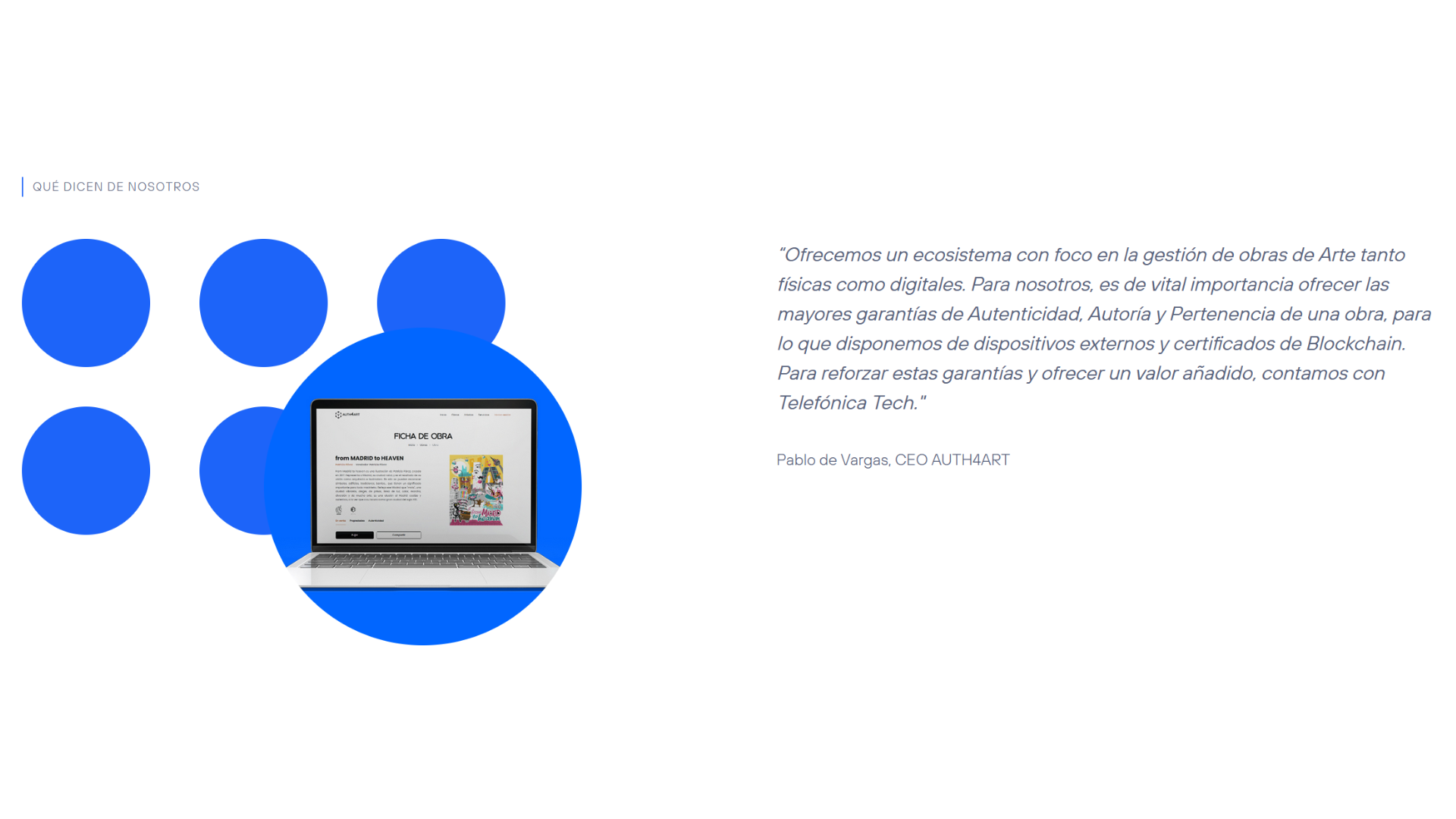
Auth4art offers a digital ecosystem of artworks with the possibility of generating NFTs of any of them and the corresponding auction.
Auth4Art currently hosts in its Marketplace more than 200 digital artworks by 3 different authors, including Cristóbal Toral. Its platform registers and authenticates both physical and digital artworks through Blockchain technology. In addition, it offers the author the possibility to decide whether his work will be public or not, to generate an NFT of it and to put it up for sale through an auction or direct sale in a controlled environment. Each author has complete control of each of his or her works and knows with total security any sale or transfer event as they are registered in Blockchain and validated by the author himself. This is possible thanks to TrustOS authenticity certificates, digital certificates with legal validity that ensure the authorship and ownership of digital content marketed as NFTs.
https://catedratelefonicauma.es/wp-content/uploads/2022/10/casoexito_telefonicatech_22.png10801920Leticia Crespillohttps://catedratelefonicauma.es/wp-content/uploads/2024/10/catedra-2024-cab-web.pngLeticia Crespillo2022-10-30 20:06:132023-03-07 07:24:32Auth4art: digital artworks in the form of NFTs (telefonicatech.com)
This weekend, the Bay will witness the first ever retransmission of the world of a SailGP event with drones 5G SA thanks to Telefónica Spain's collaboration with SailGP.
Specifically, three professional drones (DJI Matrice 300, Mavic 3 Cine and a fast FPV drone capable of flying at 100 kilometres per hour) equipped with 5G SA connectivity will closely follow the world's fastest catamarans.
https://catedratelefonicauma.es/wp-content/uploads/2022/09/SailGPCadiz_drone.png10801920Leticia Crespillohttps://catedratelefonicauma.es/wp-content/uploads/2024/10/catedra-2024-cab-web.pngLeticia Crespillo2022-09-26 10:54:412023-03-07 07:24:33SailGp and Telefónica España support the 5G SA drone relay of the event
Telefónica presents five use cases with the Malaga Police for more efficient urban mobility management, based on 5G technology.
At the University of Malaga, three other use cases have been developed to offer students immersive educational experiences and remote access to laboratory equipment.
University of Malaga: the future of education thanks to 5G: Telefónica is working with teachers at the University of Malaga (UMA) in the development of advanced education technology tools that use Virtual Reality and the virtualisation of physical devices. With these proposals, they will offer their students immersive educational experiences and access to laboratory equipment remotely with a user experience as if they were working with that equipment physically inside the university's laboratories, facilitating remote access for students to educational resources in the current pandemic situation and improving the educational experience with the application of the latest technologies. One of the three 5G-based use cases that have been carried out with the Virtual Teaching Service and the UMA Institute of Technology and Software Engineering has consisted of the use of a virtual world to facilitate online teaching between students and teachers where they can interact and where the teacher can make use of audiovisual resources to teach their subjects. The computer system used is Opensimulator, which allows the interaction of avatars in a 3D virtual world.
https://catedratelefonicauma.es/wp-content/uploads/2022/09/telefonica_ochocasos_5Gmalaga.png16202880Leticia Crespillohttps://catedratelefonicauma.es/wp-content/uploads/2024/10/catedra-2024-cab-web.pngLeticia Crespillo2022-09-09 10:17:202023-03-07 07:24:33Telefónica presents eight 5G pilot use cases in Málaga
We may request cookies to be set on your device. We use cookies to let us know when you visit our websites, how you interact with us, to enrich your user experience, and to customize your relationship with our website.
Click on the different category headings to find out more. You can also change some of your preferences. Note that blocking some types of cookies may impact your experience on our websites and the services we are able to offer..
Essential Website Cookies
These cookies are strictly necessary to provide you with services available through our website and to use some of its features.
Because these cookies are strictly necessary to deliver the website, refusing them will have impact how our site functions. You always can block or delete cookies by changing your browser settings and force blocking all cookies on this website. But this will always prompt you to accept/refuse cookies when revisiting our site.
We fully respect if you want to refuse cookies but to avoid asking you again and again kindly allow us to store a cookie for that. You are free to opt out any time or opt in for other cookies to get a better experience. If you refuse cookies we will remove all set cookies in our domain.
We provide you with a list of stored cookies on your computer in our domain so you can check what we stored. Due to security reasons we are not able to show or modify cookies from other domains. You can check these in your browser security settings.
Other external services
We also use different external services like Google Webfonts, Google Maps, and external Video providers. Since these providers may collect personal data like your IP address we allow you to block them here. Please be aware that this might heavily reduce the functionality and appearance of our site. Changes will take effect once you reload the page.
Google Webfont Settings:
Google Map Settings:
Google reCaptcha Settings:
Vimeo and Youtube video embeds:
Privacy Policy
You can read about our cookies and privacy settings in detail on our Privacy Policy Page.